
COLUMN
21/11/2026
The Kubernetes Benefits Checklist: How to Tell If Your Cluster Is Actually Delivering Them
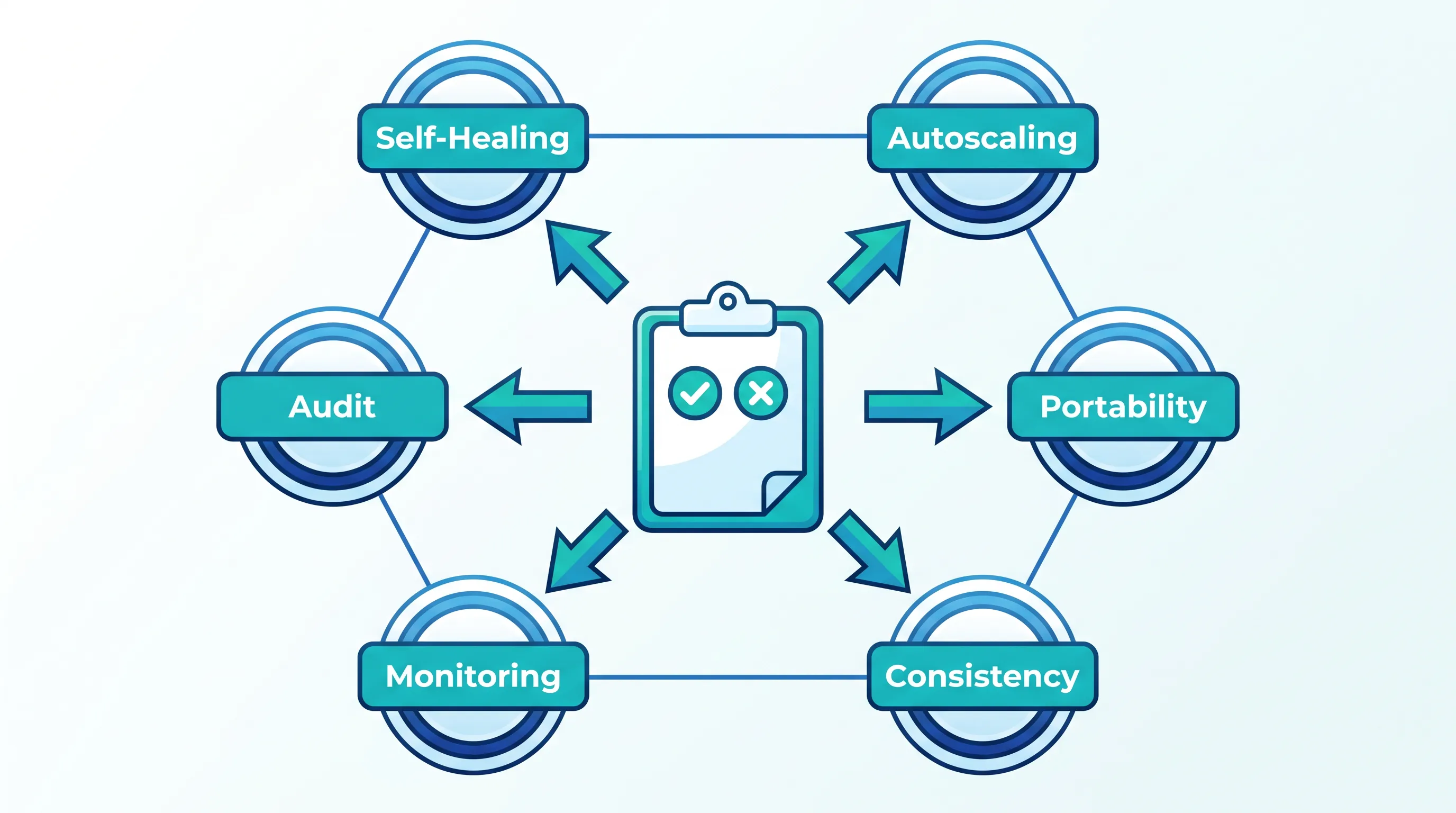
Most teams don't ask "should we use Kubernetes" anymore — they already did, eighteen months ago, under deadline pressure. The harder question is quieter: is the cluster actually giving you the benefits it promised, or did you just trade one set of problems for a more expensive one? Nobody schedules a meeting to find out.
Why "Kubernetes benefits" is a checklist, not a verdict
Search for "Kubernetes benefits" and you'll get lists: self-healing, autoscaling, portability, resource efficiency. Those are real capabilities. What the lists don't tell you is that every one of them is conditional — Kubernetes makes the capability possible, but your manifests, your monitoring, and your on-call habits decide whether you're actually using it.
A cluster that restarts a crashed pod is not the same as a cluster that recovers from failure without anyone noticing. A Horizontal Pod Autoscaler object is not the same as autoscaling that responds to real load. The gap between "the feature exists" and "the benefit is realized" is where most teams quietly lose the ROI they signed up for.
Here's how to check, benefit by benefit.
Self-healing: restarts aren't recovery
Kubernetes will restart a crashed container and reschedule a pod from a dead node. That's the mechanism. The benefit — zero-downtime recovery — only shows up if your readiness and liveness probes are configured to catch real failure, not just process death.
A common failure mode: a pod whose process is alive but whose database connection pool is exhausted. No liveness probe fires, because the process never crashed. Kubernetes has no reason to restart it. Your users see errors; your dashboards show a "healthy" pod. The self-healing benefit didn't fail — it was never wired up to detect this condition in the first place.
Checklist: Do your liveness probes test anything beyond "is the process running"? Do your readiness probes pull a pod out of rotation before it starts failing requests, not after? If you can't answer with a specific endpoint and threshold, you have the restart mechanism, not the recovery benefit.
Autoscaling: scaling on CPU is scaling on the wrong signal for most apps
The autoscaling benefit gets claimed the moment an HPA object exists in the cluster, whether or not it ever actually fires in a way that matches real demand. CPU-based autoscaling works well for compute-bound batch jobs. It works poorly for the request-latency-sensitive services most teams actually run, where the bottleneck is often I/O wait, a downstream API, or connection pool exhaustion — none of which move CPU usage.
If you've never looked at whether your HPA's scaling events line up with your actual traffic spikes, you don't know if you're getting the benefit or just paying for the controller to exist.
Portability and no lock-in: the benefit you only find out about when you try to leave
Kubernetes' most-cited benefit is that your workloads aren't welded to one cloud's proprietary APIs. That's true of the Kubernetes API itself — Deployments, Services, and Ingress objects mean roughly the same thing everywhere. It stops being true the moment your manifests depend on a managed load balancer controller, a cloud-specific storage class, or an IAM-integrated service account that only exists on one provider.
This is the benefit teams discover they never had, and only at the worst possible time: during a renegotiation, an outage, or a cost crisis, when someone asks "how fast could we move this cluster" and the honest answer involves rewriting half the YAML. Helm chart best practices are one of the more practical defenses here — templating your cloud-specific values out of the base chart keeps the portability benefit real instead of theoretical, and it makes the audit in this article much easier to run, because the drift is visible in one values file instead of buried across a dozen manifests.
Deployment consistency: the benefit that compounds, or doesn't
A declarative deployment pipeline is supposed to mean that staging and production behave the same way, and that a rollback is a single command instead of an incident. That benefit depends entirely on whether your manifests are actually the source of truth, or whether someone occasionally kubectl edits production to fix something quickly and never writes it back.
If your team can't tell you, without checking, whether what's running in production matches what's in Git, you're not getting the consistency benefit — you're getting the complexity of Kubernetes with the drift risk of hand-managed servers.
You can't audit what you don't measure
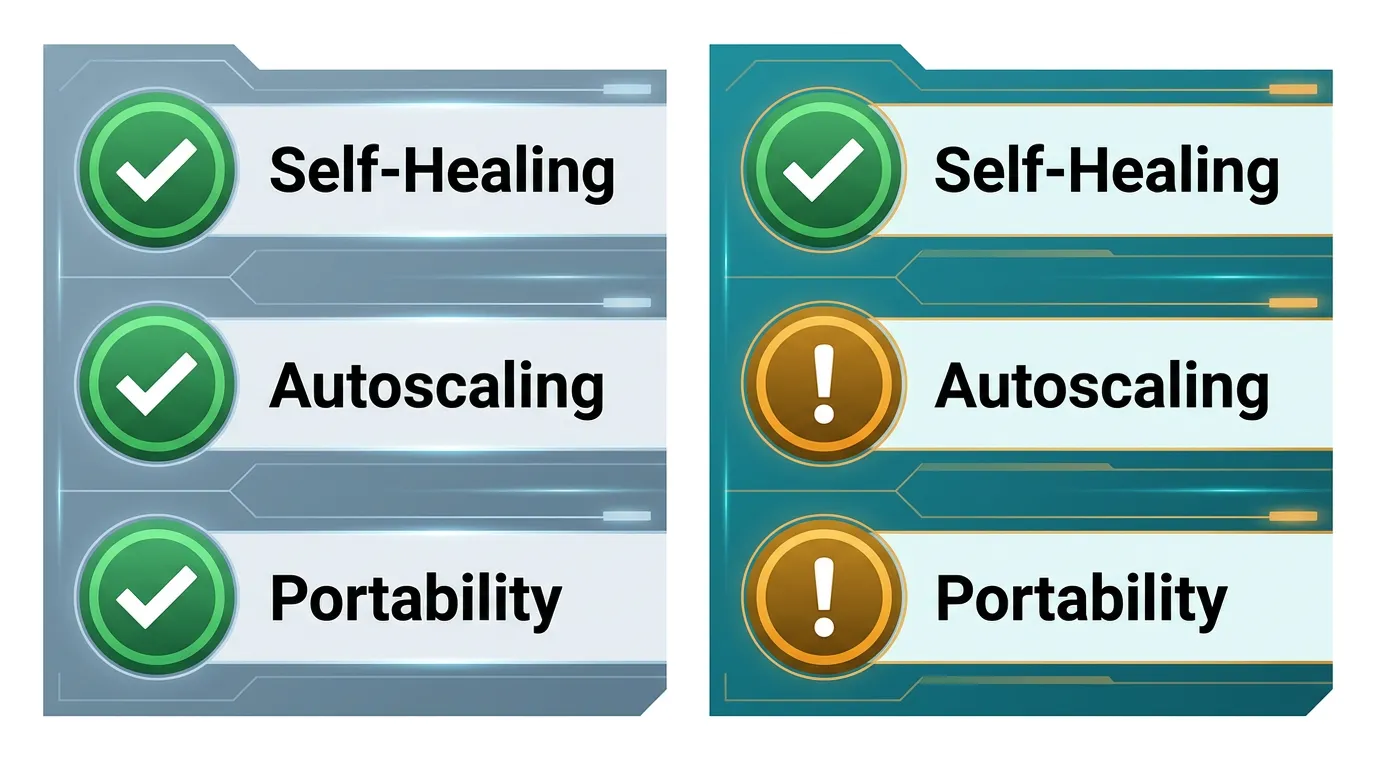
Every item on this checklist reduces to the same question: do you have the observability to prove the benefit is happening, or are you taking it on faith because the object exists in the cluster? This is where most of the gap between "we adopted Kubernetes" and "Kubernetes is paying off" actually closes.
Monitoring Kubernetes with Prometheus gives you the metrics side: pod restart counts that distinguish crash-loops from clean recoveries, HPA scaling events plotted against actual request rate, and resource usage that tells you whether your requests and limits reflect reality or a guess from eighteen months ago. Without that, "self-healing" and "autoscaling" are just words in a slide deck.
Metrics tell you that something happened; they rarely tell you why a request was slow or which service in a call chain caused a cascading failure. Distributed tracing with OpenTelemetry closes that gap — it's what turns "the autoscaler added three pods" into "the autoscaler added three pods because the payment service was holding connections open 4x longer than usual." That's the difference between auditing a benefit and guessing at one.
If you're running a cluster today without this kind of visibility, you're not in a crisis — you're just not in a position to answer the question this article is asking. That's worth fixing before it costs you a postmortem.
Where the complexity actually comes from
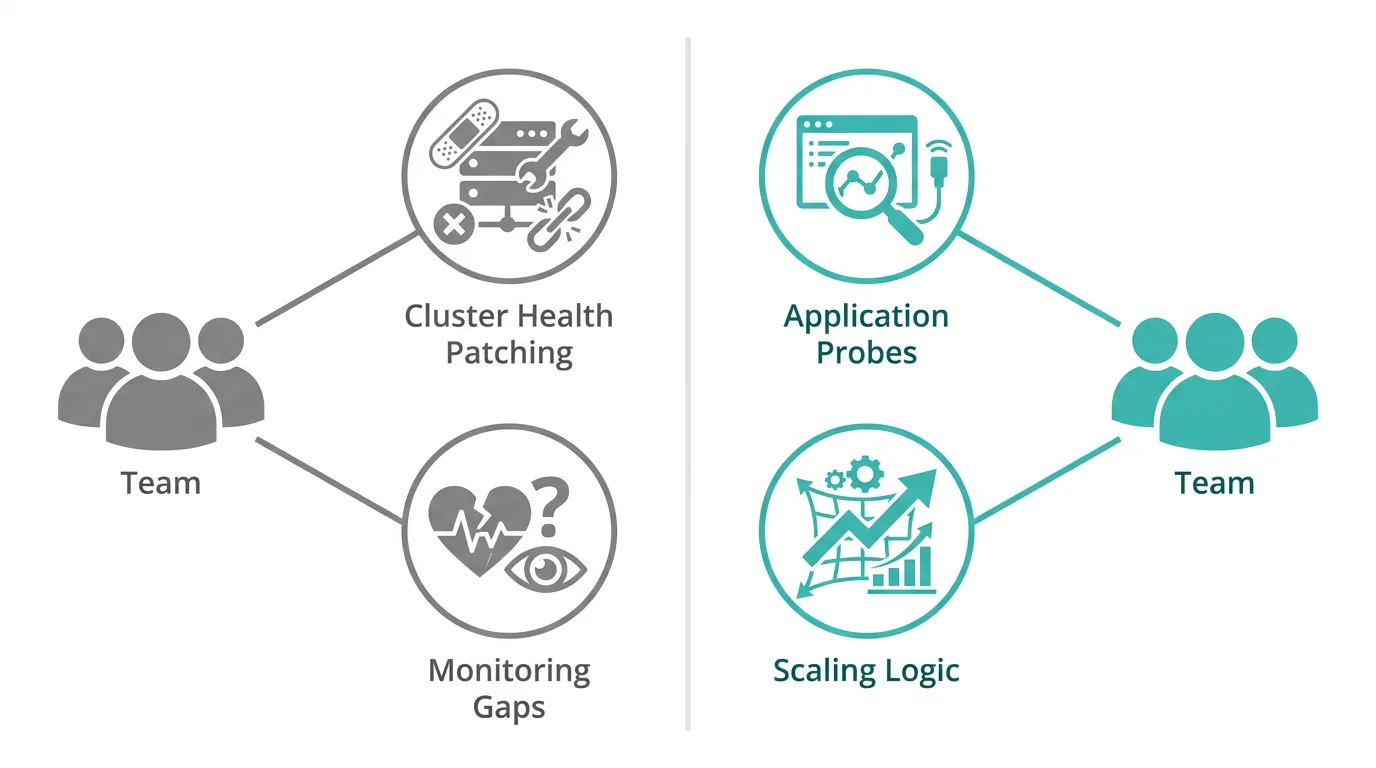
None of this is an argument against Kubernetes. It's an argument against assuming the benefits arrive automatically once the cluster exists. The honest version of the "Kubernetes benefits" list has an asterisk next to every item: if configured, monitored, and kept in sync with reality. For a lot of teams, especially smaller ones, that asterisk is exactly where the operational cost lives — not in running Kubernetes itself, but in building and maintaining the scaffolding that makes its benefits real.
Kubo exists for that specific gap. It's standard Kubernetes — the same API objects, the same Helm charts, the same probes and HPAs described above — so nothing in this checklist changes. What changes is who's responsible for the parts that usually erode quietly: node-level health, cluster upgrades, and the baseline monitoring that makes this kind of audit possible on day one instead of something you build after an incident forces the question.
Run the audit before you run the next adoption meeting
If you're the one who decided to adopt Kubernetes, or you're the one being asked whether it was worth it, the checklist above is a better answer than a slide about self-healing and portability. Go through the four items — probes that test real failure, autoscaling tied to real signals, portability that survives an actual migration attempt, and manifests that match what's running — and be honest about how many you can check without looking anything up.
For the ones you can't check today, the fix is rarely "replace Kubernetes." It's closing the gap between the mechanism and the benefit: better probes, signal-based autoscaling, and a baseline of monitoring that doesn't depend on tribal knowledge. If part of that gap is the undifferentiated work of keeping the cluster itself healthy, compare the plans and see whether offloading that layer gets your team back to the application-level work the checklist actually depends on.