
COLUMN
26/11/2026
Next.js vs. Remix: Which One Is Actually Easier to Self-Host?
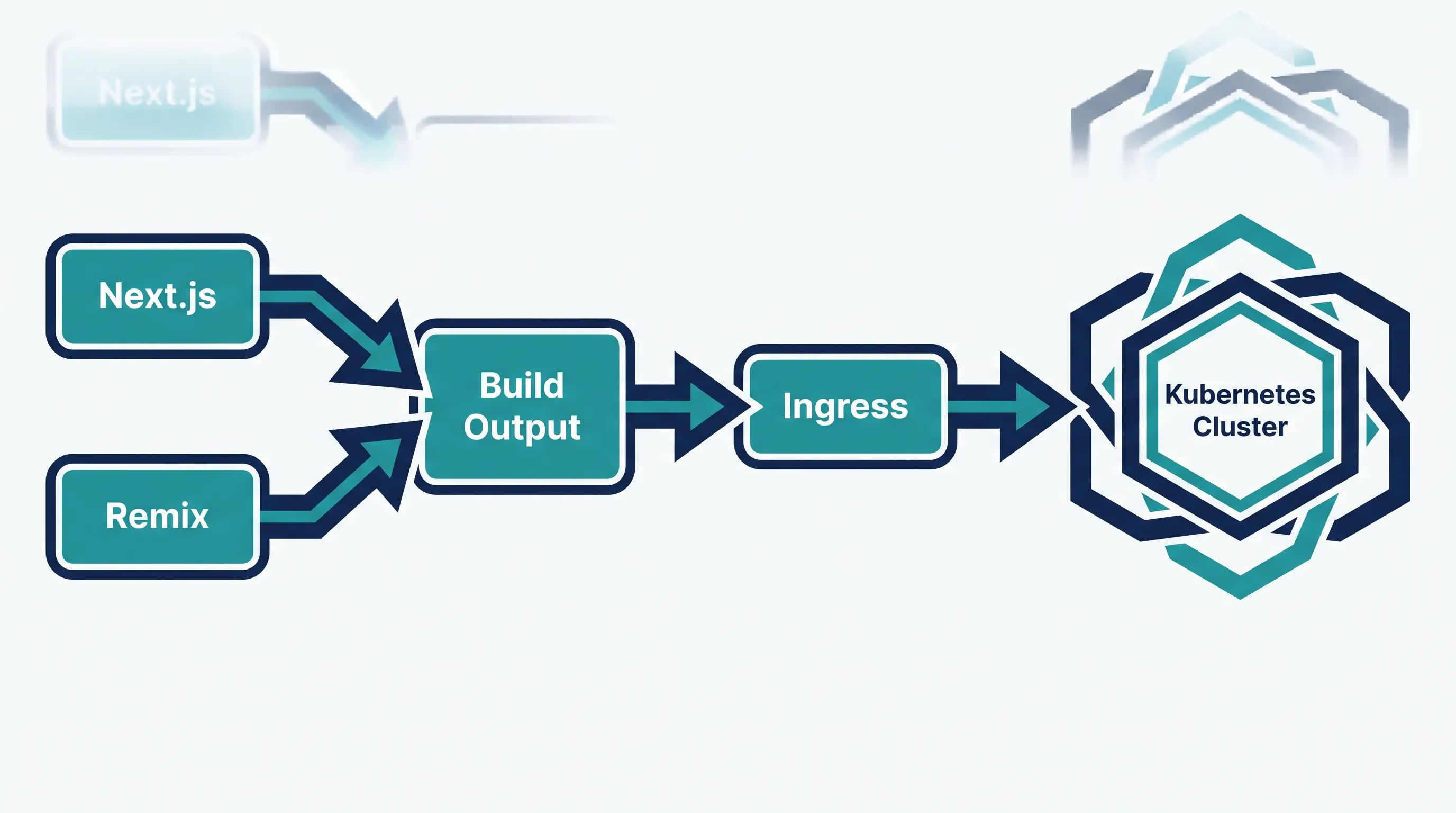
Next.js and Remix keep showing up in the same shortlist, and most comparisons settle the question with syntax: loaders versus Server Components, file conventions, data-fetching patterns. That's not the question that actually costs teams time. The question that costs time shows up three weeks after launch, when someone has to answer "how do we actually run this thing in production, and does it behave the same way on every environment we touch?"
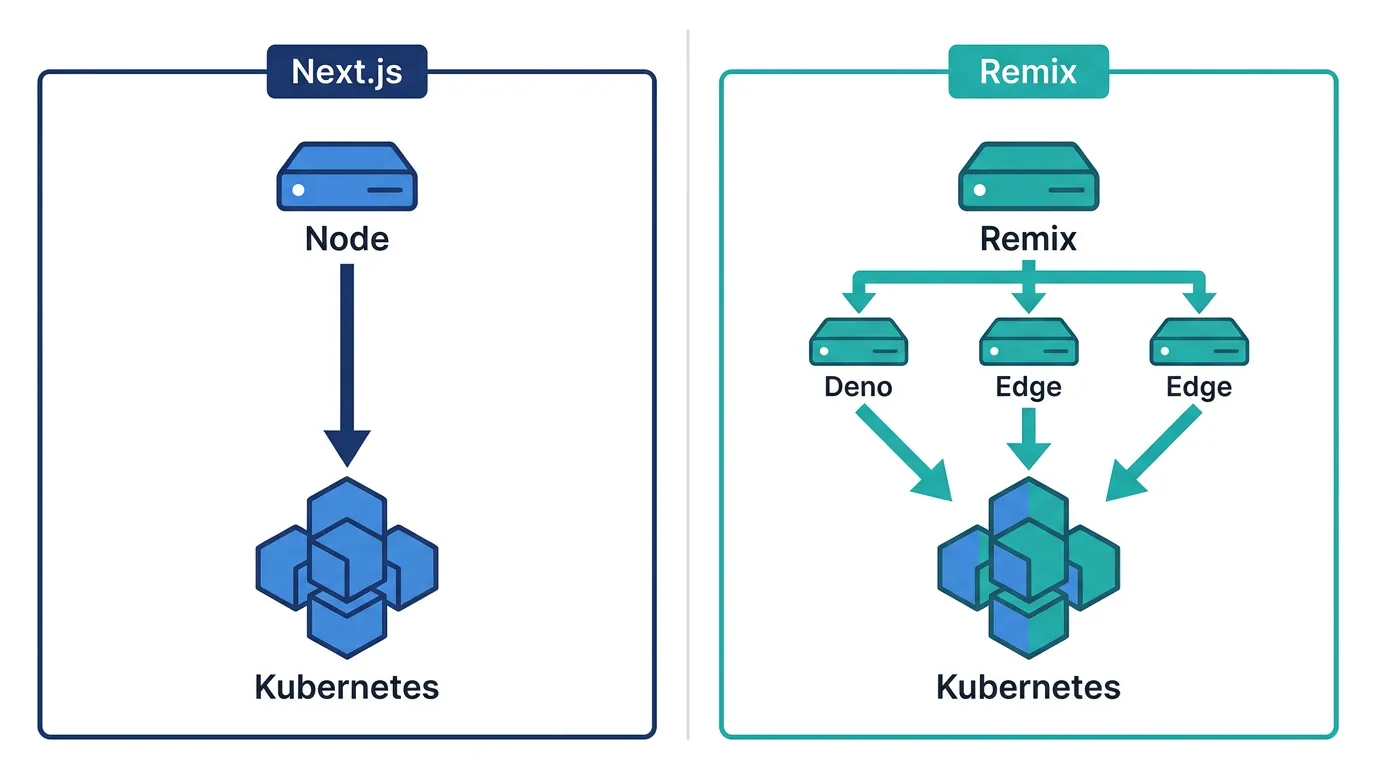
Two frameworks, two deployment philosophies
Next.js was designed with one default target in mind: Vercel. The framework's most Vercel-native features — Image Optimization, ISR, Middleware, and now parts of the React Server Components runtime — were built against Vercel's infrastructure first, then backported to a generic Node.js server through output: 'standalone'. Self-hosting Next.js works, and the official self-hosting guide is honest about what you lose: some caching behavior, the built-in image CDN, and a few runtime APIs are either degraded or require you to rebuild the equivalent yourself.
Remix was built from the opposite direction. Its core abstraction is the standard web Request/Response object, and every deployment target — Node.js, Deno, Cloudflare Workers, or a custom server — goes through the same Remix adapter interface. There's no "primary" platform the framework was optimized for first. That's a real advantage if your production target is a self-managed cluster rather than Vercel's edge network, because you're not working against defaults that assume a specific host.
Neither of these facts tells you which framework is "better." They tell you where each framework's assumptions were set, and whether those assumptions match the environment you're going to run in for the next two or three years.
Where this shows up in a real production rollout
Build output and server process. Next.js's standalone output produces a server.js file plus a pruned node_modules, which is exactly what you want in a container image — but it's an opt-in flag, not the default, and teams that skip it end up shipping an oversized image with the entire dev dependency tree. Remix's adapters produce a plain request handler you wire into whatever server you're already running (Express, Fastify, a Cloudflare Worker), so there's less framework-specific packaging to get right, but also less built-in tooling if you were hoping the framework would make that decision for you.
Instrumentation and observability. Next.js ships an instrumentation.ts hook for OpenTelemetry, but a meaningful share of the framework's internal spans (route resolution, cache hits, Server Component rendering) are tuned for Vercel's own tracing backend and arrive with less detail when you export to a different collector. Remix, having no special-cased tracing of its own, means you instrument exactly what you'd instrument for any Node request handler — less built-in detail, but no vendor-shaped gaps to work around. Either way, once you're running on your own infrastructure, you need a plan for collecting and correlating those traces yourself. Kubo's guide on implementing distributed tracing with OpenTelemetry covers how to wire a collector into a self-managed Kubernetes cluster so you're not starting from zero.
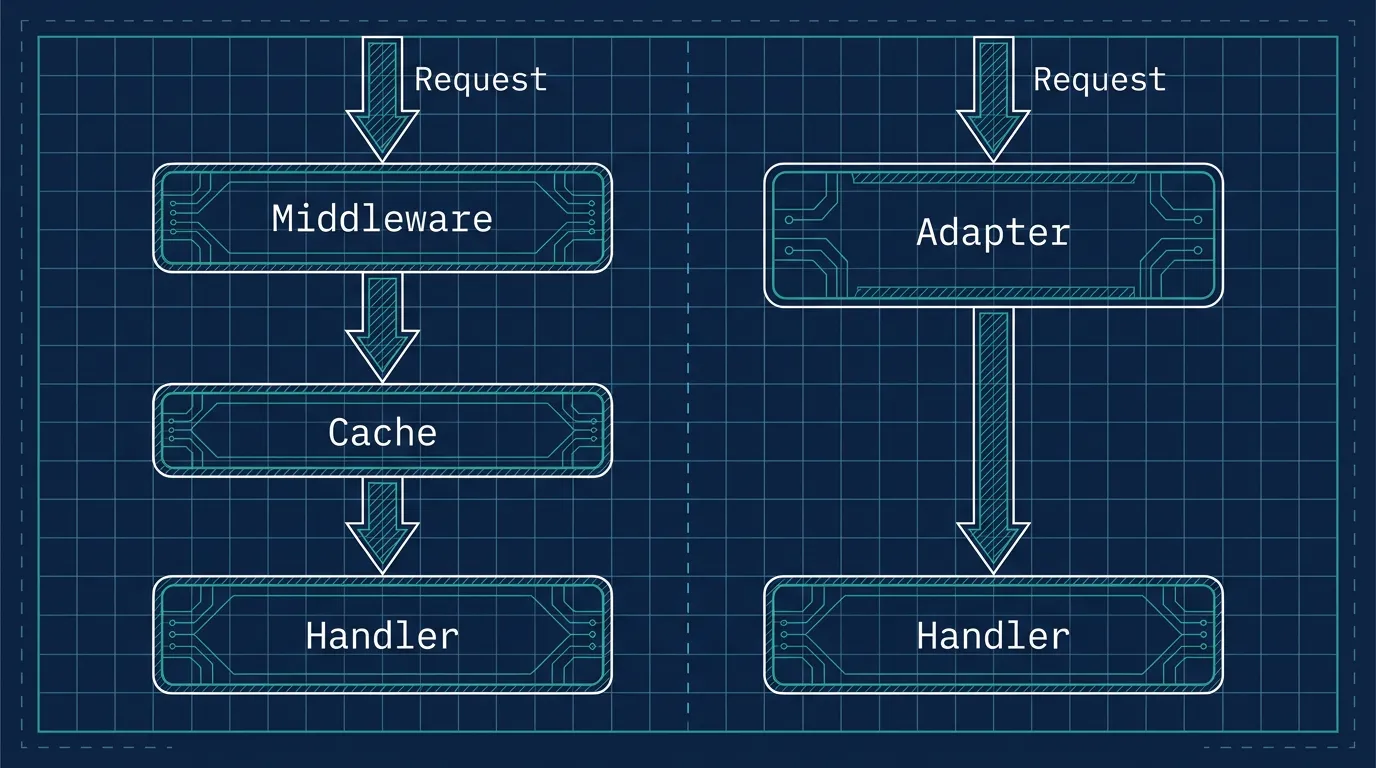
Routing and edge behavior. Both frameworks assume something sits in front of them handling TLS, redirects, and routing between services — Vercel provides that invisibly. Once you self-host, that "something" is your ingress layer, and it has to be configured explicitly: path rewrites, header forwarding, and increasingly, Gateway API instead of the older Ingress resource, since several ingress controllers are deprecating Ingress-only configurations. This part of the stack is identical regardless of which framework sits behind it, but it's the piece most comparisons skip entirely because Vercel makes it invisible.
Packaging and repeatable deploys. Whichever framework you pick, a production rollout needs a deployment artifact you can version, roll back, and promote through environments the same way every time — not a hand-run docker build someone remembers how to do. Kubo's Helm chart best practices guide walks through structuring charts so a Next.js or Remix container image becomes a release you can diff and roll back, rather than a one-off script.
A decision framework, not a winner
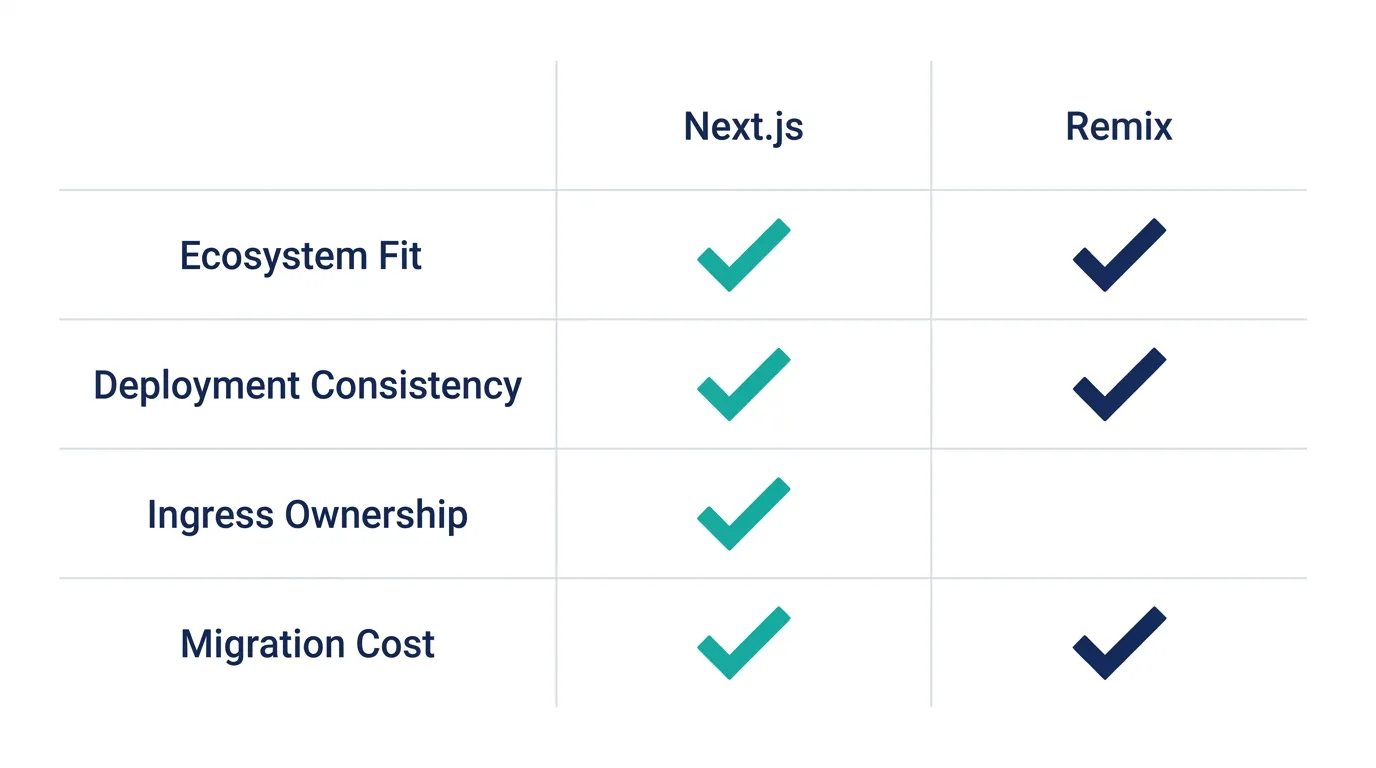
| If this describes your situation | Lean toward |
|---|---|
| Your team is already deep in the Vercel ecosystem, or you want ISR/ Image Optimization without building the equivalent yourself | Next.js, and accept the Vercel-shaped defaults even when self-hosting |
| You need the exact same deployment behavior across local dev, staging, and multiple cloud or on-prem targets | Remix, because the adapter model keeps that behavior consistent by design |
| Your biggest unresolved question is "who owns the ingress, TLS, and autoscaling setup," not "which framework" | Either framework — the deployment platform matters more than the choice here |
| You're migrating an existing self-hosted app and want to minimize how much of the hosting layer you rebuild | Remix, if you're not already using Next.js-specific features like ISR |
The honest answer for most teams weighing this is that the framework decision is smaller than it feels, and the platform decision underneath it is bigger. A Next.js app wrapped in the right container image, Helm chart, and ingress configuration runs just as predictably as a Remix app in the same setup — the gap is in how much of that plumbing each framework assumes someone else (Vercel) already handled.
If you're past the framework question
Once the framework is picked, the work that actually determines whether production is stable is the same regardless of which one you chose: a repeatable build, a Helm chart you can promote through environments, an ingress layer that doesn't assume Vercel is routing traffic for you, and tracing that tells you what broke before a customer does. If you're weighing whether to run that stack yourself or on a managed platform, Kubo gives you standard Kubernetes — Helm charts, Gateway API, OpenTelemetry included — with a workflow closer to Vercel's than to a bare EKS cluster, and without locking either Next.js or Remix into one vendor's defaults. Start with the Helm chart guide if packaging is the part you haven't solved yet.