
COLUMN
28/11/2026
ISR Revalidations Are Billed Events: Why Your Vercel Cost Climbs Without More Traffic
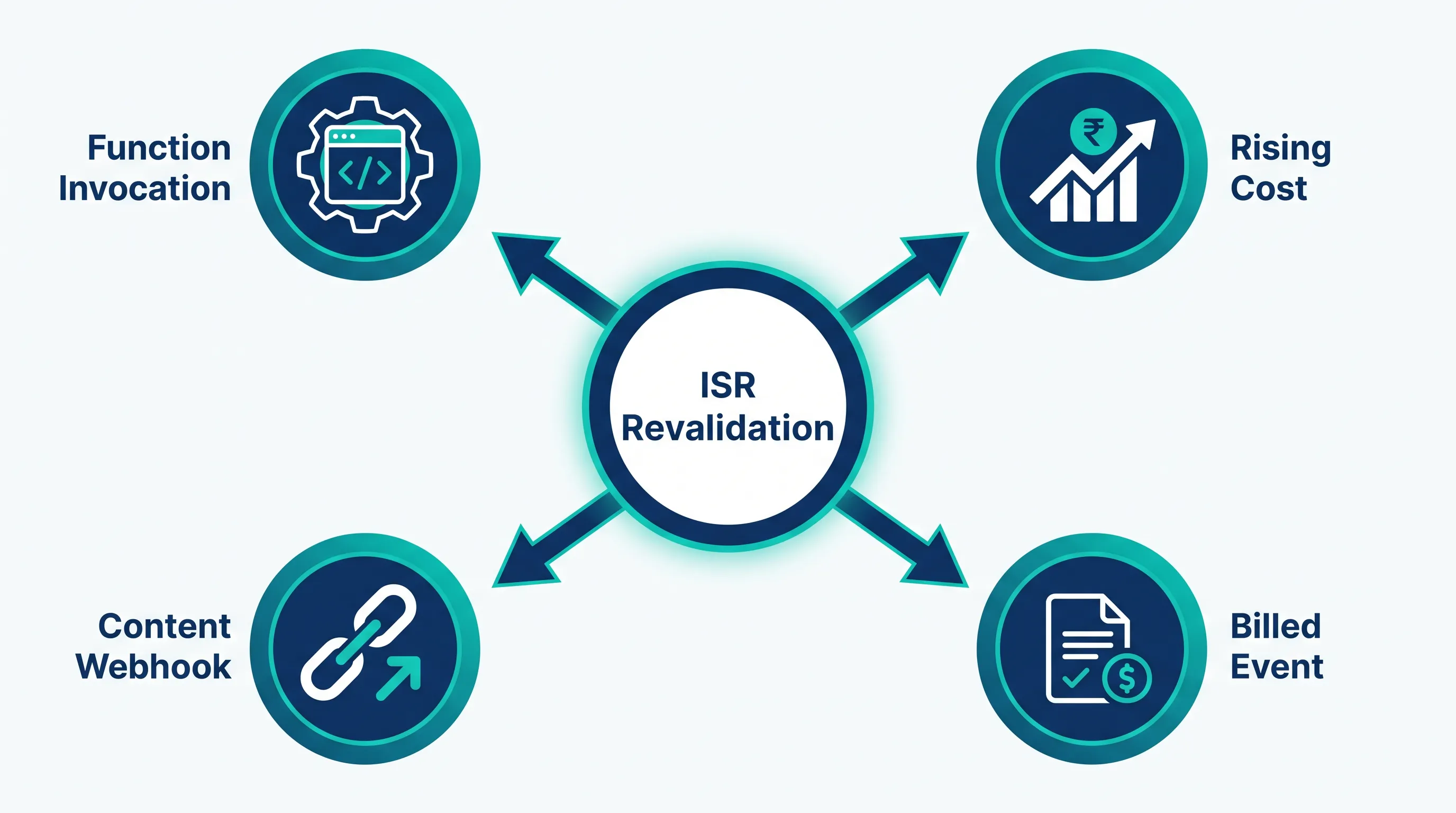
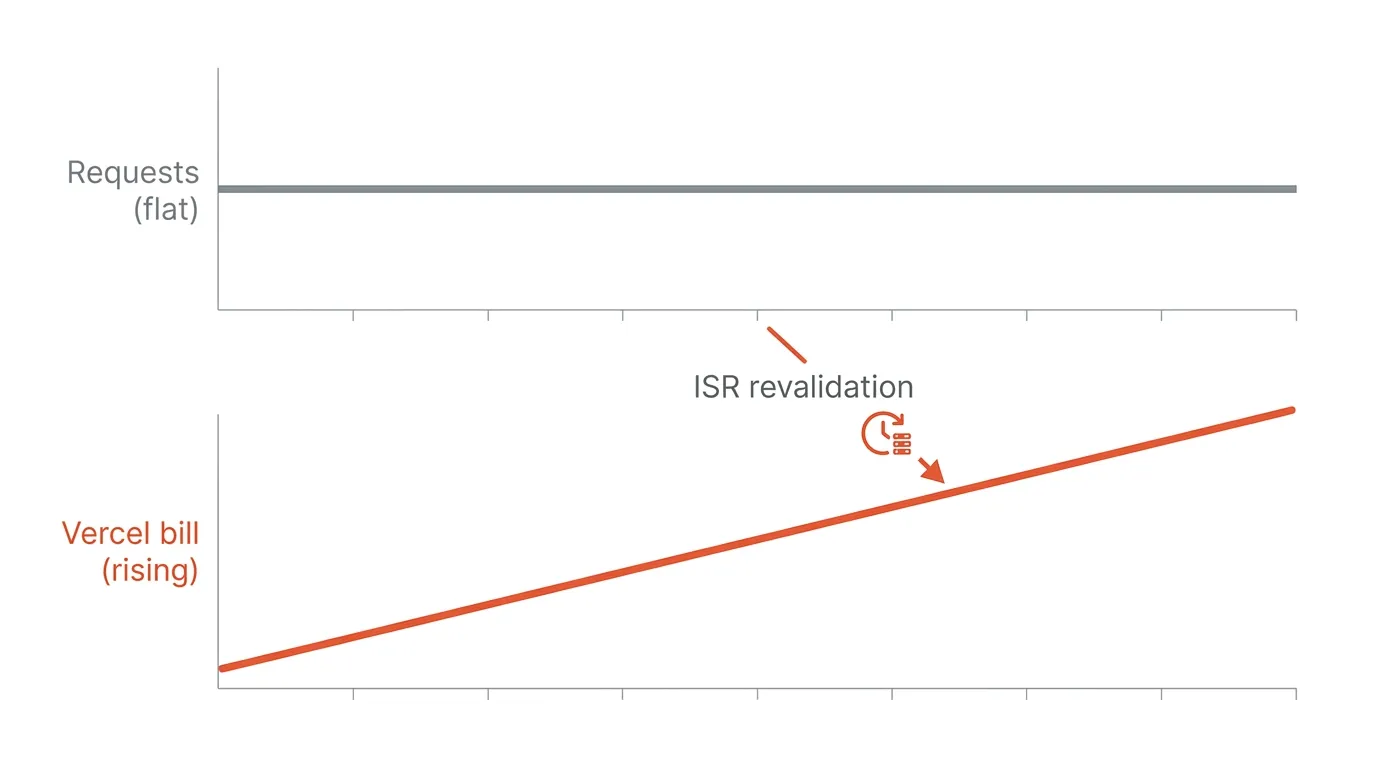
Most teams watching their Vercel bill climb assume it's traffic. More visitors, more function invocations, more cost — that story makes sense, and it's usually wrong. If your app uses Incremental Static Regeneration (ISR), a large share of your bill can come from pages nobody is even looking at yet.
ISR Is a Background Job, Not a Cache Hit
With revalidate on a page or a tag-based revalidateTag() call, Next.js doesn't just mark a cached page as stale and move on. Behind the scenes, Vercel runs your page's data-fetching and rendering code again to produce the new HTML — effectively a serverless function invocation — then stores the result. The Next.js documentation on ISR describes this as regeneration "in the background," which is accurate but easy to misread as free.
It isn't free. Vercel's own pricing documentation counts ISR writes and the function execution behind them as billed usage, separate from the page views your visitors generate. A revalidation that nobody requested yet — triggered by a cron job, a webhook from your CMS, or a wide revalidateTag() call — still consumes a function invocation and a write.
Where the Bill Quietly Grows
Three patterns push ISR costs up without a matching rise in traffic:
- Short
revalidatewindows on high-page-count routes. Arevalidate: 60on a catalog with 50,000 product pages doesn't mean "refresh each page once a minute when visited." Combined with on-demand revalidation from a CMS webhook, it can mean regenerating thousands of pages on every content change, whether or not those pages see a single visit between updates. - Tag-based revalidation that's broader than intended.
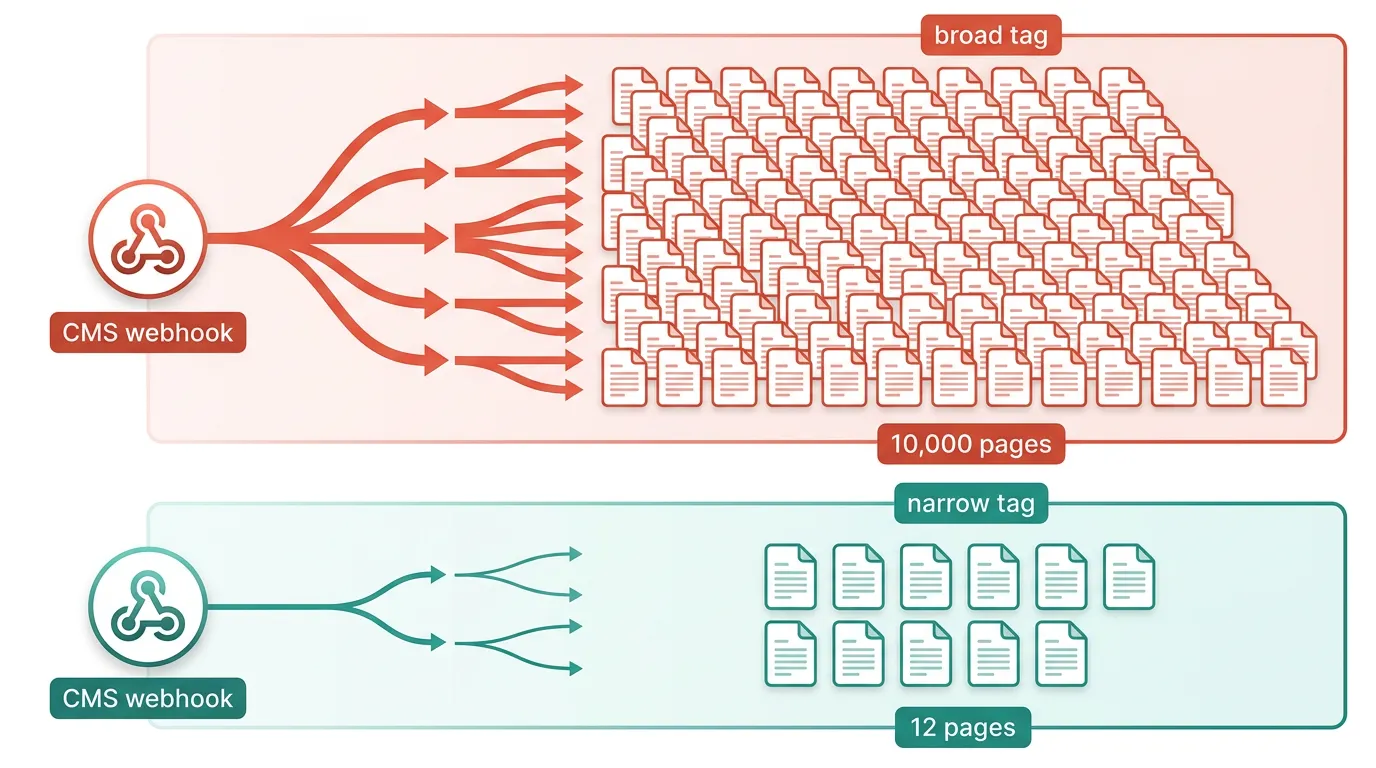
revalidateTag("products")invalidates every page taggedproductsin one call. If that tag is attached to 10,000 pages instead of the 12 that actually changed, you've just queued 10,000 regenerations for one content edit — a pattern we covered in detail in whyrevalidateTag()can hit far more than one pod in a multi-instance deployment. - Cron-triggered revalidation during low-traffic hours. A nightly job that revalidates every page "to be safe" runs the same number of regenerations regardless of whether a single visitor shows up the next day.
None of these are bugs. They're ISR working as designed — background regeneration, decoupled from visits. The problem is that "decoupled from visits" also means "decoupled from the traffic-based cost story" most teams have in their heads.
How to Tell If This Is Actually Your Problem
Before assuming ISR is the culprit, check two things:
- Compare Vercel's usage dashboard breakdown, not just the total. Vercel's billing page splits cost by category — Edge Requests, Function Invocations, ISR Writes, Image Optimization. If ISR Writes or background Function Invocations are growing while Edge Requests (actual page views) are flat, that's the signal.
- Audit the blast radius of your revalidation tags. Grep your codebase for
revalidateTagandrevalidatePathcalls, and check how many pages each tag or path actually touches. A tag meant for "this one article" that's accidentally also applied to a shared layout or an index page will revalidate far more than intended.
If the dashboard shows ISR Writes as a small, flat line, this isn't your cost driver — look at Edge Middleware invocations or Image Optimization instead. If it's the fastest-growing line, the fix is narrowing revalidation scope before anything else: tighter tags, longer revalidate windows where staleness tolerance allows, and revalidatePath instead of a wide revalidateTag when only a handful of pages changed.
This is where most teams stall: the regeneration pattern that got you to production — broad tags, short windows, "just revalidate everything to be safe" — is exactly the pattern that makes the bill climb once your page count grows past a few hundred. Fixing the application code buys time, but it doesn't change what regeneration actually costs per invocation on serverless infrastructure.
When Narrowing Tags Isn't Enough
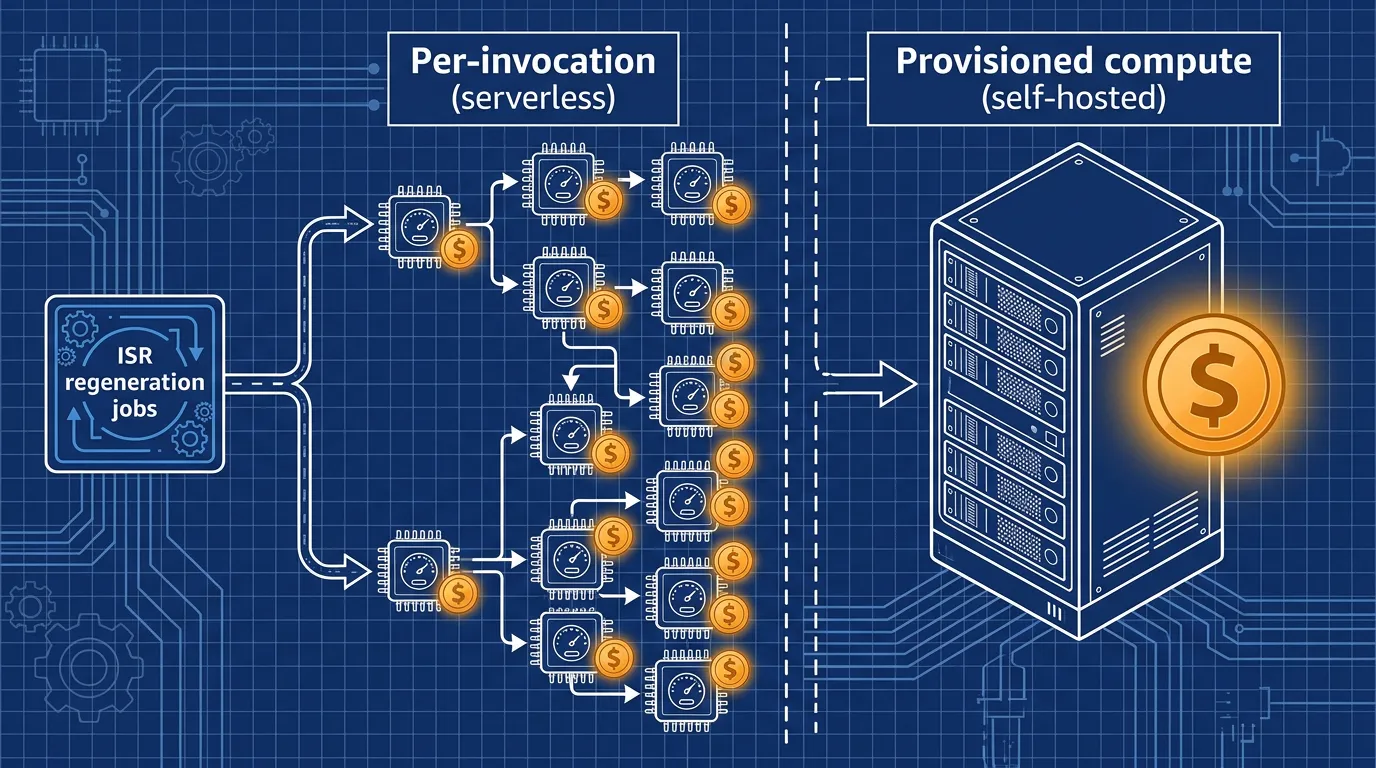
If you've audited the revalidation scope and the volume is simply a function of your page count — a content site with 50,000 pages that all need to stay reasonably fresh is going to trigger tens of thousands of regenerations a month no matter how carefully the tags are scoped — the next lever isn't code, it's infrastructure. Running the regeneration workers yourself, on infrastructure billed by the server-hour instead of per invocation, turns a cost that scales with your content volume into one that scales with the compute you provision.
This is also where the math on "just move to Kubernetes" gets questioned, fairly: full managed Kubernetes from the major clouds brings its own markup — the real cost of running Kubernetes yourself breaks down where that markup actually comes from, separate from the compute you're paying for either way. A lighter distribution like K3s keeps the standard Kubernetes API — the same Deployment, Service, and Ingress objects, the same kubectl — while cutting the control-plane overhead that drives up the managed-K8s bill.
Kubo runs that K3s control plane for you, so a Next.js app with heavy ISR regeneration can run as a standard container workload, billed for the compute you provision rather than per revalidation. For the regeneration workload itself, autoscaling instead of paying for idle capacity means the pods handling background regeneration scale with your content update volume, not with a fixed per-invocation rate.
Deciding Whether to Move the Regeneration Workload
Narrowing your revalidation tags is the first fix, and it's often enough — do that before anything else. But if your ISR Writes keep climbing because your page count or update frequency is genuinely growing, the question becomes where that regeneration work should run, not how to shrink it further.
If you're weighing that move, the practical next question is which Kubernetes distribution to run it on — a full managed offering from a hyperscaler, or something lighter purpose-built for this. Choosing between K3s and a full Kubernetes distribution walks through that trade-off directly.
On pricing: Kubo's entry-level Ashigaru plan starts at ¥8,800/month (2 vCPU, 4GB RAM), and most small-to-mid teams moving a production workload land on the Ronin plan at ¥17,600/month (4 vCPU, 8GB RAM). Compare the plans against what your ISR Writes line item actually costs this month before deciding — for a lot of content-heavy Next.js apps, that comparison is the whole decision.