
COLUMN
01/10/2026
What Is an LLM API? A Practical Guide for Developers
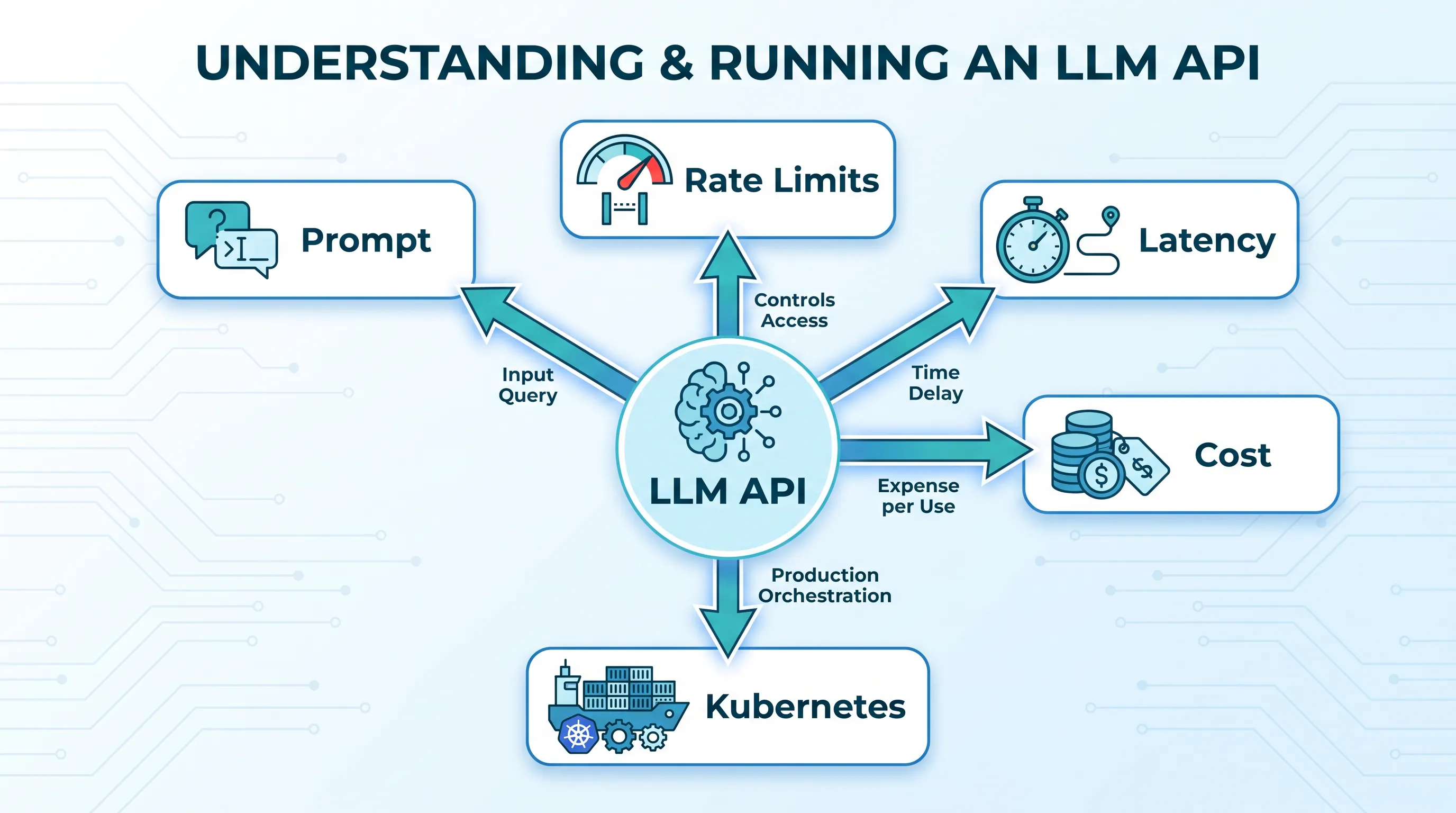
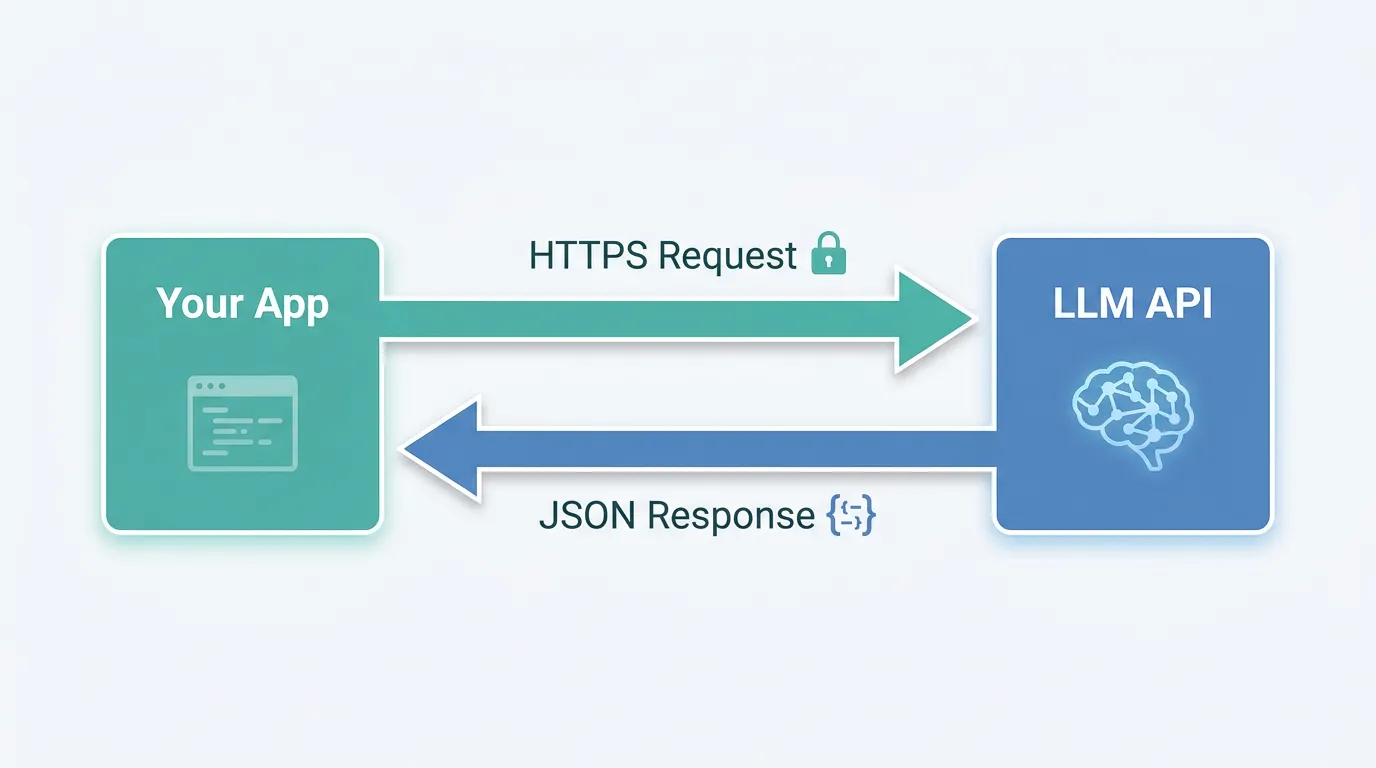
An LLM API is a hosted endpoint that lets your application send a prompt to a large language model and get a completion back, without you running the model yourself. Every major provider — OpenAI, Anthropic, Google, and others — exposes one, and most follow the same shape: you send structured JSON over HTTPS, you get a structured JSON response back, and you pay per token. Kubo isn't an LLM API provider itself; this guide is about what these APIs are and where the engineering work actually starts once you're calling one from a real product.
Calling an LLM API for the first time usually takes under ten minutes. The gap this guide covers is what happens between that first successful call and a feature that holds up under real traffic, real cost pressure, and real failure modes.
What an LLM API actually does
An LLM API wraps a trained model behind a request/response contract. You send a prompt (and usually some configuration — model name, temperature, max tokens), the provider's infrastructure runs inference on GPUs you never see, and the response comes back as text, or as a stream of tokens if you asked for streaming.
The contract is what makes these APIs interchangeable in theory and painful in practice. OpenAI's Chat Completions API and Anthropic's Messages API both accept a list of role-tagged messages and return a role-tagged response, but the parameter names, system-prompt handling, and streaming event formats differ enough that switching providers usually means touching your integration code, not just an environment variable.
Most providers bill by token — a rough proxy for compute cost — and separate the price for input tokens (what you send) from output tokens (what you get back). Output tokens are typically priced several times higher than input tokens, because generation is the expensive part of inference. That split matters once you're estimating cost at scale: a chat feature that echoes long context back to the model will cost very differently from one that returns short, structured answers.
Calling your first LLM API
A minimal call to an LLM API looks the same in any language: an HTTP POST with an API key in the headers, a JSON body with the prompt, and a JSON response you parse for the generated text. In Node.js, using the official OpenAI SDK, it's a few lines:
import OpenAI from "openai";
const client = new OpenAI({ apiKey: process.env.OPENAI_API_KEY });

const response = await client.chat.completions.create({
  model: "gpt-4o-mini",
  messages: [{ role: "user", content: "Summarize this support ticket in one sentence." }],
});

console.log(response.choices[0].message.content);
The same pattern applies with Anthropic's SDK, just with a different client and response shape. Both providers also support streaming, where the response arrives as a sequence of partial-token events instead of one blocking call — useful for chat UIs where you want text to appear as it's generated rather than after the full response completes.
This part is genuinely simple, and it's why "add an LLM API call" shows up in so many prototypes within a day. The harder questions start once that call needs to run reliably for every user, not just for you in a terminal.
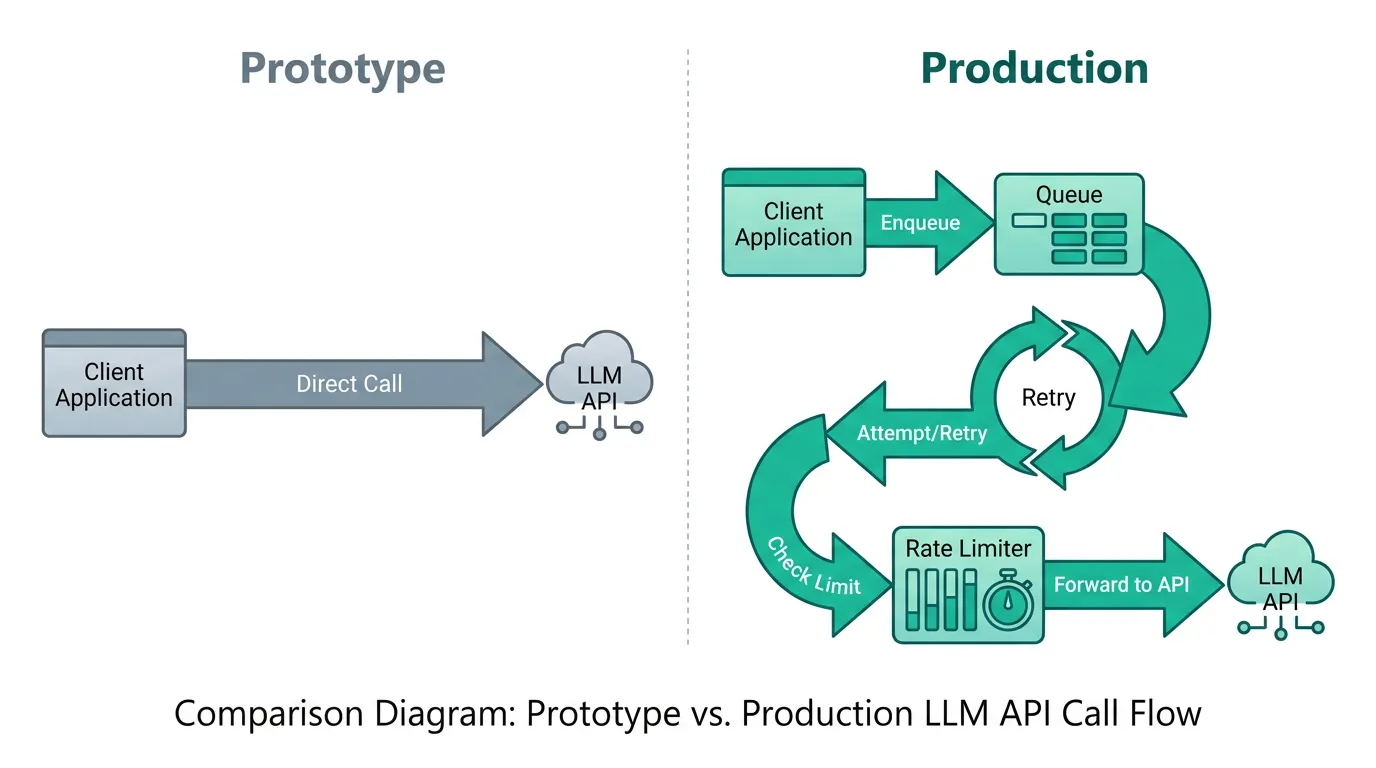
What changes once the API call ships to users
Three things tend to surface as soon as an LLM-API-backed feature gets real traffic:
- Rate limits. Providers cap requests and tokens per minute, and the limits apply per API key or org, not per end user. A feature with a handful of beta testers rarely hits them; a feature exposed to every user of a product can, especially under bursty traffic like a product launch.
- Latency variance. LLM inference latency isn't flat the way a typical CRUD API call is. A completion can take 300ms or 8 seconds depending on output length, model load, and whether you're streaming. UI and timeout handling that assume a fast, bounded response will misbehave under the slower end of that range.
- Cost that scales with usage, not with your infrastructure. There's no fixed monthly ceiling the way there is with a server you provision yourself — the bill is a direct function of how many tokens your users generate, which makes it one of the few costs in a typical stack that grows linearly with success.
None of these are reasons to avoid LLM APIs — they're reasons to treat the integration as a production dependency with its own operational surface, the same way you'd treat a database or a payment provider, rather than as a library call that either works or doesn't.
Where the infrastructure question shows up
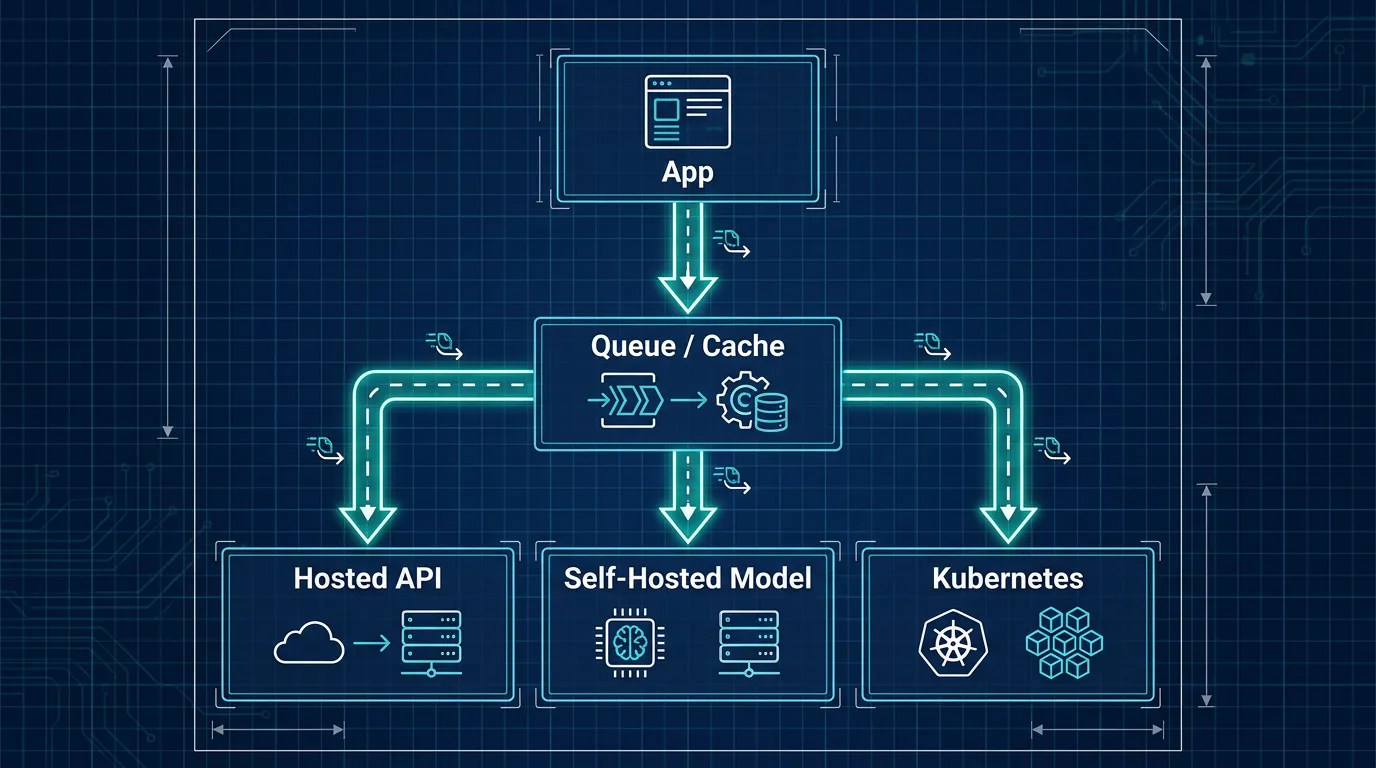
Handling rate limits and retries is application code — a queue, a backoff policy, maybe a second provider as fallback. But a growing number of teams end up running more than just "call the API": self-hosted open-weight models for cost or data-residency reasons, a caching or routing layer in front of multiple providers, or batch inference jobs that process documents overnight. That workload looks less like a stateless web request and more like a service that needs autoscaling, GPU scheduling, and cost controls — which is why 66% of AI-driven companies report standardizing on Kubernetes for exactly this layer once an LLM feature moves past prototype stage.
This is usually where teams hit the same wall self-hosted Next.js apps hit on Vercel: the workload is ready, but routing traffic to the right number of replicas, keeping GPU-backed pods from scaling up expensively when idle, and not getting surprised by a cluster bill are three separate problems to solve before a single feature ships. Autoscaling inference workloads with HPA, VPA, and KEDA is the standard Kubernetes answer to the first two; getting a clear view of the real cost of running managed Kubernetes is what usually decides whether a team runs this themselves or looks for a managed option.
A simple checklist before shipping an LLM API call to production
- Confirm your provider's rate limits (requests/minute and tokens/minute) against your expected peak traffic, not your average
- Add retry logic with exponential backoff for rate-limit and timeout errors — most SDKs support this natively
- Set a
max_tokensceiling per request so a single malformed prompt can't generate an unbounded, unexpectedly expensive response - Log token usage per request so cost is visible before the invoice arrives, not after
- Decide up front whether a slow or failed LLM call degrades the feature gracefully or blocks the user entirely
Conclusion
An LLM API is the easiest part of building with large language models — a well-documented HTTP endpoint that most developers can call successfully on the first try. The engineering work that actually determines whether an AI feature survives contact with real users is everything around that call: rate limits, latency handling, cost visibility, and eventually the infrastructure to run inference at a scale a single API key wasn't built for.
If you're weighing whether to keep routing everything through a hosted API or to bring some of that inference layer in-house, Kubo gives you standard Kubernetes with autoscaling and cost controls already wired in for exactly this kind of workload — closer to a managed experience, without locking you into one vendor.